


 Request an offer











 Weinerpark 16 | 48607 Ochtrup | Germany













Solid Wood Table Tops
Solid wood table tops combine a natural wood structure with a stable table surface for restaurants, cafés and bars. Different shapes, dimensions and surfaces allow for adaptation to interior concept, available space and operational processes.
 Filter
 Grid view
 Product view
 In line
 Masonry View
Solid Wood Table Tops Clearly Categorised
Solid wood table tops are table tops whose supporting core consists of solid wood or laminated solid wood slats. They differ from melamine and HPL tops by their genuine wood structure, tactile surface, and natural variations in grain and colour tone.
In restaurants, cafés and bars, they support a warm, artisanal room image. Oak appears calm and distinctive, while visible slats, finger-joint connections or a live edge emphasise a more rustic character. Especially in window areas, booth niches or zones for longer stays, the natural surface can provide a deliberate contrast to metal frames, concrete look and smooth wall surfaces. Under warm evening light, wood tone and grain usually appear more intense; in daylight, the same top looks more neutral. Samples should therefore be assessed under the actual lighting conditions of the establishment.
Formats and Space Planning in the Dining Area
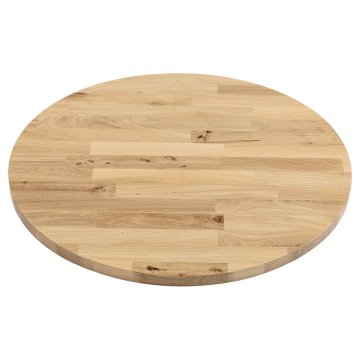
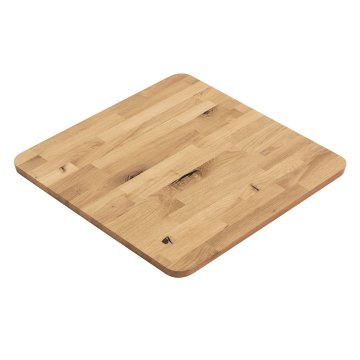
The shape also influences table occupancy and movement space. Round tops with a diameter of about 60 cm are suitable for small two-person tables and gentle walkways. Square formats such as 60 x 60 or 70 x 70 cm can be placed in a straight line against walls and combined into groups if needed. Rectangular sizes like 110 x 60 or 120 x 70 cm offer more space for full place settings, breakfast or several dishes served together.
Plan not only the top size, but also chair clearance, legroom and service routes. A 50 mm thick top appears more substantial, but is heavier than a 25 or 35 mm thick version. This affects daily rearrangement and the choice of base. For larger rectangular tops, a double table frame may be advisable; compact two-person tops can often be combined with central table frames. Load-bearing surface, fixing points and stability must always match the specific model. If you frequently switch between two- and four-person settings, you should also choose a uniform size grid so that table edges align neatly.
Surface, Care and Area of Use
Solid wood reacts more strongly to moisture, heat and cleaning chemicals than coated tops. Spilled drinks, grease and food residues should be removed promptly. For regular cleaning, a soft, slightly damp cloth and a material-appropriate agent are usually sufficient; standing moisture, scouring pads and aggressive cleaners can impair the surface or sealant. Hot containers should not be placed without a suitable base.
Check before purchase whether the top is oiled, lacquered or otherwise sealed and which care instructions apply. Equally important is the distinction between continuously solid wood and a solid wood core with real wood veneer. For terraces and outdoor seating, only models expressly designated for outdoor use are suitable; many solid wood table tops are intended for indoor use.
Decision Criteria for Solid Wood Table Tops
Four criteria are particularly relevant: Firstly, the type of wood and surface finish must match the maintenance requirements of the establishment. Secondly, shape and dimensions determine whether the top is suitable for two-seaters, group tables or generous menus. Thirdly, thickness, weight and edge shape of the top influence the spatial effect as well as handling. Fourthly, the assembly with the intended frame must be clarified. Some tops are delivered without pre-drilled holes and fixing screws; screw length, frame support and position of the drill points must therefore be checked before assembly.
Quick-Check
- Indoor or explicitly designated outdoor use
- Type of solid wood, sealing and care instructions
- Round, square or rectangular to suit occupancy
- Top thickness and weight to suit frequency of rearrangement
- Clarify frame support, drilling pattern and fixing material in advance
Combine Furnishings Harmoniously
Solid wood table tops can be staged in an industrial style with black metal frames, in a restrained way with simple column frames, or particularly warmly with wooden components. The combination with suitable chairs should take into account proportion, seat height and space for movement. In quieter zones, banquette seating can continue the natural material effect and at the same time support longer stays. Those who prefer complete solutions instead of individual components will find already coordinated table variants under bistro tables.
A well-maintained, stable and aesthetically suitable table surface immediately shapes the perception of quality. If guests feel comfortable and the table works well in daily service, this can encourage longer stays, repeat orders and return visits. However, the possible operational effect only arises in combination with good layout, suitable seating distances, lighting, acoustics and reliable maintenance.
Solid wood table tops are particularly suitable for establishments that consciously use real wood structure as part of their interior concept. Decisive are not only appearance and type of wood, but the right combination of format, surface, substructure and use in daily operations.



















