


 Request an offer











 Weinerpark 16 | 48607 Ochtrup | Germany












Oval Table Tops
Oval table tops combine a generous table surface with softly rounded contours. They are suitable for restaurants, cafés and hotels wishing to harmoniously integrate longer table groups into the dining area.
 Filter
 Grid view
 Product view
 In line
 Masonry View
Oval Table Tops: Correctly Classifying Shape and Use
Oval table tops are elongated table tops with a continuously rounded contour or softly rounded ends. They combine the usable length of rectangular tops with a more flowing line and are particularly suitable for larger table groups in indoor areas.
In restaurants, cafés and hotel lounges, oval tops support a calm, open spatial impression. Along window axes or in a spacious central zone, formats such as 160 × 90, 180 × 90 or 200 × 100 cm appear less angular than comparable rectangles. Round-oval variants appear especially soft, while Danish oval or boat shape create a longer, clearer silhouette. Compared to round tops, they offer more longitudinal surface; compared to rectangular tops, they lack prominent corners. The actual space requirement, however, still depends on width, length, seating and walkways.
Space Planning, Seating and Service Routes
The rounded ends can make it easier to pass by the ends of tables and reduce hard edges in walkways. This is useful, for example, near wide service routes or in areas intended for longer evening stays. For fast lunch rotation, however, large oval group tables are only suitable if demand and occupancy regularly match. Otherwise, smaller, flexibly combinable bistro tables may be more economical.
When planning, consider not only the top dimensions, but also the space for pushed-back gastro chairs, service and guest traffic. Seats at the narrow ends require sufficient depth and legroom. A centrally positioned substructure can create freedom of movement, but for long tops must match the span. Double frames or spider constructions often distribute the load more suitably than a single small base. Before ordering, the base plate, bearing surface and recommended top size of the frame should be checked.
Material, Surface and Assembly in Everyday Gastronomy
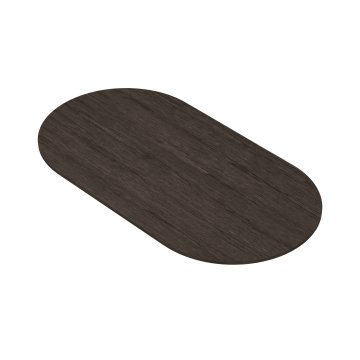
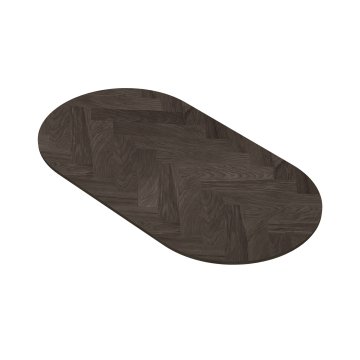
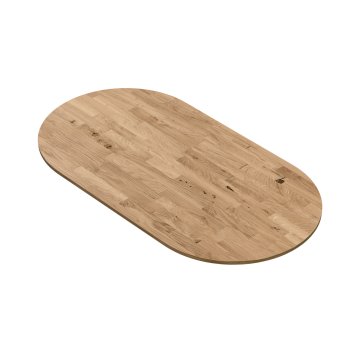
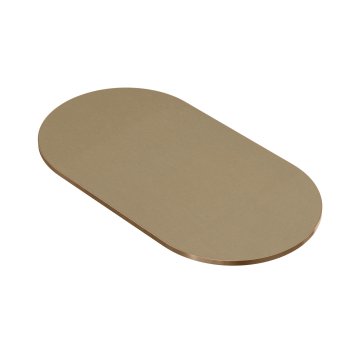
The current range includes oval versions made from solid European oak, solid driftwood, as well as solid spruce with oak veneer. Surfaces range from smooth wood grain to stick design and striking herringbone pattern; natural tones and dark variants support both warm and high-contrast guest areas. Depending on the series, material thicknesses are, for example, 25, 40 or 60 mm. A thick tabletop is visually prominent, but also increases weight and requirements for the substructure.
For frequent wiping, closed, evenly finished surfaces and easily accessible edges are important. Moisture should be removed promptly and the cleaning agent adapted to the respective wood or veneer surface. The oval GGM versions are designated for indoor use; for terraces, explicitly suitable weatherproof gastro tabletops made from outdoor materials should be chosen.
For several Fishbone versions, delivery is without pre-drilling, fastening screws and table frame. Therefore, coordinate drilling pattern, screw length, tabletop thickness and bearing surface with the selected table frames. Also note that nominal and actual dimensions may vary depending on the model.
Four Decision Criteria for Oval Tabletops
Shape and proportion: Round-oval appears softer, Danish oval more elongated; both shapes should match the room axis and group size. Dimension: Compact 130 × 80 cm are suitable differently than 230 × 110 cm large tables, which require significantly more space and a sturdy frame. Surface: Herringbone sets a visible accent, smooth or stick-glued oak appears calmer. Substructure and assembly: Weight, span, bearing points and fastening must be planned together to ensure the tabletop remains stable in operation.
Quick-Check
- Select oval shape to match room axis and desired seating arrangement
- Plan for the actual product dimension rather than just the nominal dimension
- Test end seats, chair backs and tray routes in the floor plan
- Match tabletop weight and span with the frame
- Define care instructions for solid wood or veneer
Harmonious Combination and Economic Impact
An oval tabletop is convincing when frame, chairs, lighting and other table shapes support the same design line. Black metal frames emphasise modern herringbone tops, while calmer wood surfaces fit well into classic restaurant and hotel concepts. If several table shapes are used, colour, edge effect and material appearance should be repeated so that the guest area does not appear randomly assembled.
A stable, well-maintained table surface supports the perception of quality and pleasant use. If guests do not feel spatially cramped and the table remains functional even during longer meals, this can promote quality of stay, repeat orders and return visits. At the same time, suitable surfaces, solid fastenings and plannable service routes can reduce cleaning effort, disruptions and premature replacement.
Oval tabletops are therefore particularly suitable for businesses wishing to combine longer table surfaces with a softer spatial effect. The key is to coordinate format, surface and substructure with the actual operational process.



















