


 Request an offer











 Weinerpark 16 | 48607 Ochtrup | Germany









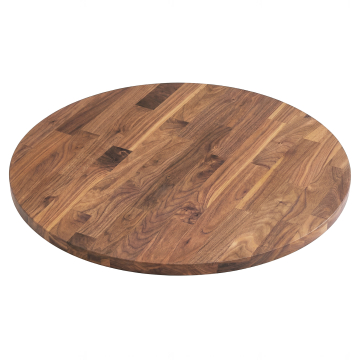
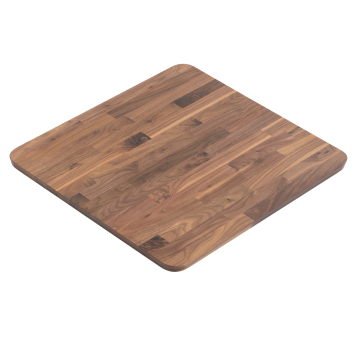


Walnut Table Tops
Walnut table tops bring warm brown tones and a distinctive wood grain to restaurants, cafés, bars and lounges. Different shapes, sizes and material versions enable needs-based table planning for hospitality interiors.
 Filter
 Grid view
 Product view
 In line
 Masonry View
Clearly categorise walnut table tops
Walnut table tops are table tops made of solid walnut wood or panels with a surface, a veneer or a colouring in walnut look. This distinction is essential for selection: Solid American walnut, real wood veneer in walnut colour and other woods with a walnut-coloured finish differ in feel, care, weight and natural grain.
Typical are warm brown to dark brown tones and a lively wood pattern. As a result, walnut table tops appear calmer and deeper than light wood surfaces, without being as severe as black tops. They are particularly suited to restaurants, wine bars, hotel lounges and café areas where a high-quality, mature spatial effect is desired.
Purposefully use spatial effect for guest areas
In window niches or along quiet wall zones, round walnut table tops with a diameter of 60 or 70 cm can create small spaces for couples. Square formats such as 60 x 60, 70 x 70 or 80 x 80 cm support flexible two-person areas; rectangular tops from around 120 x 70 cm offer more space for menus, sharing dishes or four people.
The darker surface can be combined in a matter-of-fact, modern way with black table frames or harmoniously with warm catering chairs. With strongly dimmed evening light, the grain should still remain visible. In very dark rooms, lighter upholstery, walls or targeted table lighting help to ensure the overall impression does not appear heavy.
In niches with longer stays, distinctive live edges or herringbone patterns can serve as a visual focal point. In areas with rapid turnover, clear edges and compact formats are usually easier to arrange.
Match shapes and dimensions to operational processes
The size of the top influences more than just the number of place settings. Small square tables can be grouped together if required and support a quick changeover between lunch and evening service. Round tops make it easier to pass by in narrower niches, but require a different arrangement than square models for the same usable area.
For service routes, the actual external dimension counts. For some series, this differs from the nominal size: A top described as 60 x 60 cm may actually measure 58 x 58 cm, a 70 x 70 cm variant 68 x 68 cm. Therefore, check product dimensions, chair clearance, legroom and passage together. Larger formats such as 130 x 80, 180 x 90 or 200 x 100 cm require a correspondingly dimensioned subframe and sufficient free service area.
Carefully check material, edge and assembly
For walnut table tops, the precise material specification determines everyday operations. Solid walnut variants, for example, are available with a thickness of 25 mm. Other series combine walnut colour with oak veneer, while live edge models may consist of other solid woods in a walnut finish. Table top thicknesses of 30, 40, 50, 60 or 80 mm are also available and alter the weight, appearance and requirements for the frame.
Herringbone surfaces and Swiss edges appear lighter and more decorative than straight, robust live edges. For frequent wiping, mild cleaners and soft cloths should be used; abrasive sponges and aggressive chemicals can damage veneered or sealed surfaces. Liquids and stains should be removed promptly. For terraces, only variants explicitly designated as suitable for outdoor use are advisable.
For some series, the tops are supplied without pre-drilled holes; screws and frames must be selected separately. Ensure that mounting surface, screw length, top thickness and stability are coordinated. If you wish to compare material types, you will find a suitable neighbouring category in Massivholz-Tischplatten.
Quick check for walnut table tops
- Check material specification: solid walnut, real wood veneer or walnut look
- Match nominal and actual dimensions for seating plan and walkways
- Select edge shape to suit style, impact resistance and movement zone
- Explicitly check suitability for indoor or outdoor usePlan frame mounting, fixing materials and top weight together
Combine furnishing and cost-effectiveness
A well-maintained walnut surface, stable fixing and harmonious combination can support the perceived quality of the dining area. If guests feel comfortable at a sufficiently large, wobble-free table, they may stay longer, are more likely to order another drink or return. For lunch service, on the other hand, a flexible mix of small formats can facilitate table rotation and occupancy; however, a direct sales effect is never guaranteed.
For a consistent interior, walnut table tops can be compared with complete bistro tables of the same design language. It is crucial that colour, top thickness, frame and seating are not chosen in isolation. This creates a table system that matches the room, the menu and the desired pace of use.



















