


 Request an offer











 Weinerpark 16 | 48607 Ochtrup | Germany









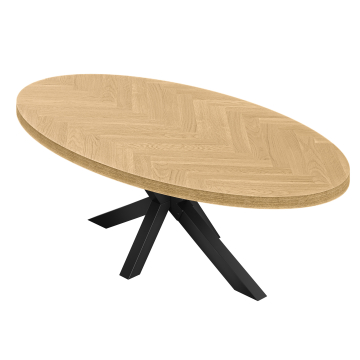
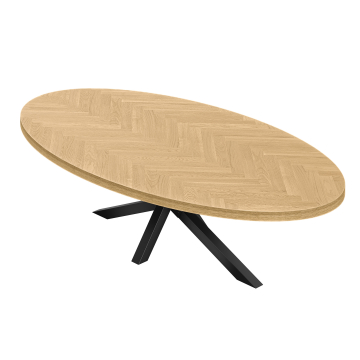
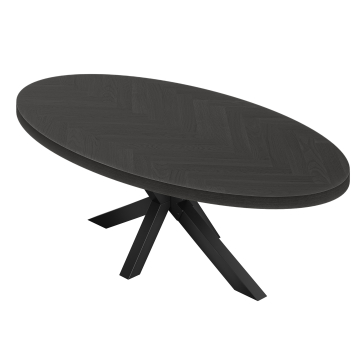


Oval restaurant tables
Oval restaurant tables combine generous table surfaces with softly rounded contours and are particularly suitable for longer seating groups in restaurants, cafés and hotels. Different proportions and wood surfaces allow for targeted coordination with room axes, group sizes and interior design concepts.
 Filter
 Grid view
 Product view
 In line
 Masonry View
Oval Restaurant Tables: Correctly Classifying Shape and Use
Oval restaurant tables are elongated tables for the hospitality sector with a continuously rounded contour or softly rounded ends. They combine the usable length of rectangular tables with a more flowing line and are particularly suitable for larger seating groups in restaurants, cafés, and hotels.
In the dining area, oval tables appear calmer and less angular than comparably long rectangles. Round-oval shapes support a soft, communicative room image, while Danish oval or boat shapes appear more elongated and defined. In window axes, spacious central zones, or longer bench areas, the shape can pick up the room direction without placing hard table corners in walkways. The actual space requirement still depends on length, width, seating, and passageways.
Planning Proportions for Seating, Service Routes, and Zoning
With oval restaurant tables, it is not just the table length that is decisive. Formats around 130 × 80 cm require a different environment than variants measuring 180 × 90, 200 × 100, or 230 × 110 cm. As the length increases, so do the requirements for free chair movement, sufficient table spacing, and a stable substructure.
The rounded ends make it easier to visually integrate the table into passageways, but do not replace proper route planning. Test in the floor plan whether guests can move chairs back without blocking the service route, and whether there is enough space at the table ends for movement. For group areas, it should also be checked how many seats can actually be used comfortably; a theoretically possible seating arrangement should not come at the expense of legroom or tray routes.
Aligning Material, Surface, and Substructure with Everyday Hospitality Needs
At GGM Möbel, oval versions can be found in oak, oak veneer, as well as with herringbone surfaces. Smooth wooden surfaces appear calmer, while herringbone emphasises the tabletop more as a design element. Depending on the model, panel thickness, construction, and actual dimensions differ; therefore, not only nominal dimensions but also the specific product data should be included in space planning.
For daily operations, frequent wiping, stains, moisture, impacts, and stressed edge zones are important factors. For wood and veneer, care should match the respective surface treatment; suitability for heat, standing moisture, or stronger cleaning chemicals must be checked for each model. For terraces, only versions that are expressly intended for outdoor use should be used. For separately selected restaurant table tops, the top can be supplied without pre-drilling. Drilling pattern, screw length, panel thickness, and bearing surface must then match the table frames so that the finished table can be assembled stably and securely against tipping.
These Criteria Are Decisive for Oval Restaurant Tables
Shape and Proportion: Round-oval appears softer, Danish oval or boat shape more elongated. The shape should match the room axis and desired group size.
Dimensions: Length and width determine not only the usable area but also chair positions and passageways. Actual product dimensions may differ from nominal dimensions.
Surface: Herringbone sets a visible accent; calmer wood structures are easier to combine with striking chairs or benches.
Substructure and Span: Longer panels require sufficient support and a frame suitable for the size. Weight and fastening should be planned together.
Quick Check
- Select oval shape to match room axis and seating arrangement
- Enter actual table dimensions including chair backs into the floor plan
- Practically test end seats and service routes
- Select surface according to cleaning schedule and level of use
- Check frame, bearing surface, and fastening before assembly
Combining Comfort and Cost-Effectiveness
A well-maintained, stable table influences how guests perceive quality, tranquillity and care within the space. When shape, spacing and seating interact harmoniously, this can encourage guests to stay longer, order more, or visit the establishment again. Thus, a coherent interior can also positively affect the revenue potential per occupied seat, although no guarantee can be derived from this.
The operational effect, however, does not arise from the shape alone. Tables that are too large can tie up valuable space, while seating that is too cramped can impair comfort and service. Therefore, the performance of the entire zone is crucial: suitable table size, functional walkways, surfaces that are easy to maintain, and a number of seats that matches the mix of times of day.
Harmoniously combining oval restaurant tables
For a cohesive overall look, the tabletop, base and seating furniture should be coordinated. Those who assemble an oval tabletop individually can combine it with a matching base; for smaller or more frequently changing seating groups, additional bistro tables can be a sensible choice. Material tones and frame colours should be considered together with chairs, benches, flooring and lighting, so that the oval shape appears intentional and not like a foreign object in the room.
Oval restaurant tables are particularly interesting when longer table groups with a softer contour are planned. Those who check proportion, actual dimensions, surface and base together will obtain a reliable basis for a functional and harmonious restaurant zone.



















