


 Request an offer











 Weinerpark 16 | 48607 Ochtrup | Germany












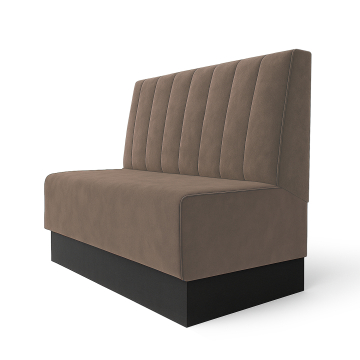


Velvet benches for gastronomy, restaurant and café
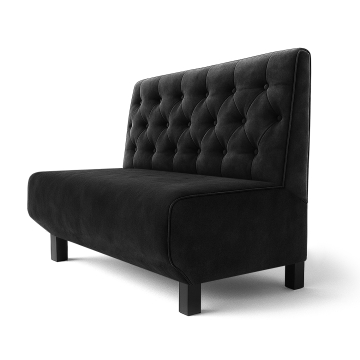
Velvet benches combine upholstered seating comfort with expressive design for restaurants, cafés, bars and hotel areas. Choose suitable colours, widths and upholstery designs for your interior concept and the requirements of your business.
 Filter
 GGM ansicht
 Grid view
 Product view
 In line
 Masonry View
Velvet benches set targeted accents in the dining area
Velvet benches are upholstered restaurant benches with a soft, slightly shimmering cover, whose pile makes colours appear lighter or darker depending on the light. They are particularly suitable for businesses that want to combine comfortable seating with a clearly recognisable material effect.
In a restaurant alcove, a dark green or midnight blue velvet bench can provide a calm counterpoint to light table tops. In window areas, beige, grey or muted rose tones appear lighter and can be easily integrated into bright café concepts. In the evening, the pile gains visual depth under warm light, while it appears more neutral in daylight.
The upholstery pattern also influences the character. Smooth back surfaces appear modern and understated. Vertical stitching visually elongates high backrests, while diamond or Chesterfield stitching points more towards classic restaurant and bar settings. Thus, velvet models stand out not only through the material, but also clearly from other restaurant benches.
Coordinate dimensions and placement with operational workflow
Before making a selection, bench width, seat depth, seat height and backrest height should be considered together. A wide, high backrest can create a sheltered alcove, but requires more visual space than a low, smoothly upholstered model.
For planning, it is not only a matter of how many guests can theoretically be seated on a bench. What is crucial is whether table edge, seating position and legroom fit together. There must be enough space between table rows for guests to stand up without blocking the service route. Especially in passages to the kitchen, at service stations or next to heavily used walkways, there should be sufficient distance for trays, chair backs and oncoming guests.
Straight bench elements are suitable for wall areas and clearly structured table rows. Corner solutions can make use of unused areas, but are less flexible for changing group sizes. Before installation, it should be checked whether individual modules need to be screwed together and whether wall, floor and skirting boards allow for a flush placement.
Correctly assessing upholstery, pile and padding in everyday use
Velvet is often chosen for its soft feel and intense colour perception. For use in the hospitality sector, however, the specific upholstery quality is more important than the mere material designation. Wear, risk of staining and cleaning routines differ significantly between a breakfast café, a cocktail bar or a busy restaurant.
Pay particular attention to the following decision criteria:
- Suitability of the upholstery for commercial use
- Care instructions and permitted cleaning agents
- Padding firmness for the intended duration of stay
- Workmanship of seams, edges and impact zones
- Available widths and suitable complementary elements
Liquids and food residues should be treated as soon as possible in accordance with the manufacturer's instructions. Vigorous rubbing can visibly alter the pile. Moisture on lower edges, frequent bumping by cleaning equipment and the load on the front seat edge should also be considered in the selection. Businesses with particularly high levels of staining can use velvet specifically in selected bench niches and complement other areas with more easily wiped [leather benches].
Quick check for selecting velvet benches
- Does the colour match in daylight and under evening lighting?
- Does the quilting support the desired style?
- Are seat height, table height and legroom compatible?
- Are walkways and service distances sufficiently wide?
- Does the care effort correspond to daily operations?
Economically classifying comfort and spatial effect
A well-maintained, stable and harmoniously placed velvet bench can enhance the perceived value of a dining area. Guests notice not only the colour and fabric, but also seating comfort, cleanliness, distance to the neighbouring table and the tranquillity of a well-planned niche.
For longer evening visits, upholstered bench seats can promote a pleasant quality of stay. In fast-paced lunchtime business, however, it is important that the padding is not too deep and guests can stand up comfortably. Economically relevant factors are therefore not only purchase price and number of seats, but also care effort, service life, reparability and the possibility of reordering matching elements later.
Integrating velvet benches into a harmonious interior concept
Velvet is particularly effective in combination with table surfaces, lighting and wall design. Dark velvet tones can, for example, be combined with wood decors and warm metallic accents. Anthracite or black suit minimalist interiors with clean lines. Strong colours should be used selectively so that the room does not appear restless.
For a uniform seating concept, velvet models can be combined with matching upholstered chairs. In areas at a raised counter, however, appropriately dimensioned bar high benches are required, as standard velvet benches are designed for typical dining table heights.
The right velvet bench is thus created from the interplay of colour, upholstery design, dimensions and operational use. Those who take lighting conditions, walkways and care requirements into account early on will achieve a solution that fits the design concept and proves itself in daily hospitality operations.



















