


 Request an offer











 Weinerpark 16 | 48607 Ochtrup | Germany









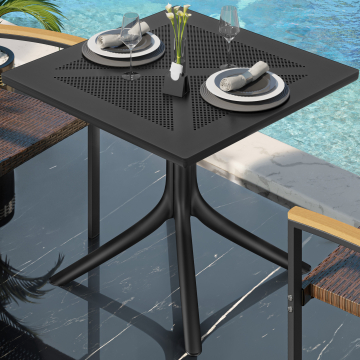


Plastic tables for the hospitality industry
Plastic tables for the hospitality industry offer easy-care table solutions for restaurants, cafés, terraces and flexible event spaces. Depending on the design, they are suitable for fixed seating areas or frequently changing arrangements.
 Filter
 Grid view
 Product view
 In line
 Masonry View
Targeted use of plastic tables in the hospitality industry
Plastic tables for the hospitality sector are tables whose top or entire construction is made of robust plastic and are designed for frequent use, easy maintenance and – depending on the model – for indoor and outdoor use. They are particularly suitable for terraces, bistros, snack bars, event areas and spaces where furniture is regularly cleaned or rearranged.
A clear, minimalist design supports modern, straightforward hospitality concepts. On terrace edges or in areas with high turnover, compact formats create a tidy appearance and can be easily combined with plastic chairs. For events or seasonal areas, foldable versions are of interest, as they can be stored more space-efficiently after use and repositioned more quickly.
Planning dimensions, shape and space requirements correctly
With plastic tables, the shape determines how flexibly a space can be used. A square bistro table measuring 80 x 80 cm is suitable for compact seating groups of two to four guests and can be easily arranged in regular rows. Round event and standing tables, on the other hand, encourage open group formation and can be useful at receptions or for short stays. The GGM range includes not only fixed plastic bistro tables but also foldable party tables, for example rectangular formats around 183 x 76 cm and large round versions, as well as standing tables.
Pay attention not only to the table surface, but also to chair backs, legroom and service routes. Especially with lightweight tables, the arrangement should be planned so that passageways remain clear and frequent rearrangement does not cause disruption to service. For seasonal outdoor areas, combining with standing tables can provide additional flexibility.
Plastic surfaces in daily hospitality operations
Plastic is particularly attractive in everyday hospitality due to its easy-care, moisture-resistant surface. For designated outdoor models, weather and UV resistance are added benefits. This is practical for frequent wiping, drink stains and changing weather conditions. Nevertheless, edges and table legs should be regularly checked for knocks, damage and secure stability.
A concrete example is a square outdoor bistro table with 80 x 80 cm, approximately 76 cm total height and a plastic top about 35 mm thick. For event use, there are also foldable models made of polyethylene or HDPE with a powder-coated steel frame. In hot conditions: observe the temperature release of the respective model and do not place very hot objects without suitable protection.
If you plan the top and substructure separately, you must check compatibility. A plastic top may be intended for a specific system and is therefore not automatically compatible with any table bases. Fastening materials may also be required separately depending on the model; for individual components, therefore, check product information before assembly. Alternatives for other material requirements can be found under gastro table tops.
Decision criteria for plastic tables in the hospitality industry
Four criteria are particularly relevant for selection: Firstly, the use indoors, outdoors or alternating. Secondly, the table size and shape to suit dishes, group size and available space. Thirdly, handling – fixed, foldable or height-adjustable – depending on seasonal operation, events and storage space. Fourthly, the base construction, as low weight makes rearrangement easier but still requires a stable, tip-resistant setup.
Quick-Check
- Check the place of use and weather approval of the model
- Adapt table format to two-, four-person or event groups
- Consider folding function and storage size for frequent rearrangement
- Assess surface, edges and cleaning effort for daily operation
- For individual parts, clarify mounting, screws and frame compatibility in advance
Combining spatial effect and economic use
Plastic tables can support a functional, modern and uncomplicated outdoor or bistro design. It is crucial that material, colour and shape match the chairs, sun protection and the rest of the interior concept. A uniform black bistro table appears restrained and clear; light-coloured or foldable event tables are more suitable for flexible, functional seating arrangements.
A well-maintained, stable and harmonious interior can influence how guests perceive the cleanliness, comfort and quality of an establishment. Where guests feel comfortable, a longer stay can encourage repeat orders and return visits; in faster-paced concepts, on the other hand, well-planned, easily rearranged furnishings can support rotation. The economic effect is therefore not created by plastic alone, but by suitable product quality, good zoning and a workflow that matches the business.
For selection, therefore, not only the purchase price counts. Check how often the tables are moved, how they are cleaned and stored, and whether the shape and size will fit the space concept in the long term. In this way, an easy-care material becomes a functional solution for everyday gastronomy.



















